

The watch that made simplicity heroic
Among all the great watch archetypes, few are as quietly influential as the field watch. It does not announce itself like a dive watch with a rotating bezel, nor does it carry the romance of a moonwatch or the polished glamour of a dress piece. And yet, for many collectors, the field watch is where the love of practical horology begins.
Its appeal is deceptively simple: clear numerals, sturdy construction, compact proportions, and the sense that every design choice exists for a reason. The field watch is one of the purest expressions of tool-watch philosophy. To understand why it remains so beloved today—from seasoned military-watch collectors to newcomers buying their first Hamilton Khaki or Seiko 5—it helps to look back at how this genre was formed.
Born from necessity, not fashion
The field watch owes its existence to war, but also to a broader shift in how time was worn. In the late 19th and early 20th centuries, pocket watches were still the norm for men. That began to change when soldiers discovered that consulting a pocket watch in combat was awkward, slow, and sometimes dangerous. Wrist-worn timekeepers, once considered delicate or even feminine, suddenly became practical instruments.
The trench watches of World War I were transitional objects: often pocket-watch movements adapted into wristwatch cases with wire lugs, luminous numerals, and protective grills over the crystal. They were not yet “field watches” as we think of them now, but they established the essential idea that a military watch had to be legible at a glance, durable under stress, and easy to wear with both hands free.
That change in use reshaped taste. Function began dictating form. Large Arabic numerals, bold hands, dark dials, and luminous paint became part of a new visual language—one that still defines the category more than a century later.
The military specification era
If World War I introduced the military wristwatch, the middle decades of the 20th century refined it into the field watch proper. During World War II, watches were increasingly built to specification. In the United States, the A-11 became one of the most important military watches ever made, produced by brands such as Hamilton, Elgin, and Waltham. It was modest in size, manually wound, and designed above all for readability and synchronization.
Across the Atlantic, Britain issued the famous “Dirty Dozen,” a group of watches made to Ministry of Defence specifications by twelve Swiss manufacturers. These pieces have become collector touchstones not because they are ornate, but because they embody a kind of design honesty that modern enthusiasts find irresistible.
Postwar military watches continued that lineage. Hamilton and Benrus produced watches to U.S. specifications like the MIL-W-3818B and GG-W-113, many with hacking seconds for precise coordination. Their matte dials, 24-hour markings, and compact cases created the template that later generations would reinterpret endlessly.
It is worth pausing on that point: the field watch was never about novelty. It was about standardization, trust, and clarity. These were instruments built so that soldiers could depend on them without thinking about them.
From issued equipment to everyday icon
After the wars, military aesthetics moved into civilian life. Surplus watches were inexpensive, reliable, and already associated with toughness. Just as importantly, the field watch fit daily life beautifully. It slipped under a cuff, looked right on canvas or leather, and felt honest rather than showy.
That made it fertile ground for mainstream brands. Timex translated military practicality for mass-market America. Seiko and Citizen, especially later in the quartz era, built reputations around robust, no-nonsense watches that delivered real value. For many modern collectors, the Seiko SNK809 became a gateway field watch: affordable, charmingly utilitarian, and powered by an automatic movement that invited curiosity about mechanics. Citizen’s Garrison line played a similar role, offering legibility and everyday wearability without pretense.
Hamilton, though, deserves special mention for bridging history and modern collecting. The Khaki Field line remains one of the clearest living descendants of the American military watch tradition. Whether in the hand-wound Khaki Field Mechanical or its automatic siblings, the design retains the essential grammar of the genre. Modern versions may use the H-50 movement with extended power reserve rather than a vintage military caliber, but the spirit is intact.
Why collectors still chase them
Field watches endure because they reward both the eye and the wrist. They are deeply wearable, but also rich in nuance. A beginner may simply see a clean black dial and white numerals. A seasoned collector sees case proportions, handset variations, dial printing, military engravings, and the difference between an original tritium dial and a later relume.
This is where collector wisdom matters. Vintage military watches can be deeply satisfying, but they require care. Moisture damage is common. Over-polished cases can erase the sharpness that gives these watches character. Replacement hands and redials are not unusual, and with military pieces, provenance matters enormously. A watch described as “military style” is very different from one that was actually issued.
It is also wise to respect the realities of old lume. Radium-era pieces should be handled thoughtfully, and even later tritium watches may present service complications. For some collectors, that is part of the charm; for others, it makes a strong case for buying a modern reinterpretation instead of chasing a fragile original.
There is no shame in choosing the latter. In fact, many experienced enthusiasts keep both: a historically important vintage piece for the collection, and a contemporary field watch for daily wear.
The modern revival and the microbrand effect
The field watch has enjoyed a quiet renaissance over the last decade, helped in no small part by independent and microbrand makers. These companies understand that collectors appreciate restraint. A good field watch does not need to be oversized or theatrically distressed to feel credible.
Baltic, for example, has built a following by channeling vintage proportions and tonal sophistication, even when its designs drift toward the broader adventure-watch space. Farer brings color and finishing to traditionally utilitarian formats, showing that a field-adjacent watch can still feel playful. Meanwhile, many newer brands rely on dependable calibers such as the Seiko NH35 or Sellita SW200-1, proving that practicality and accessibility remain central to the genre.
This is one of the most interesting chapters in field-watch history: the category has expanded without losing itself. Modern collectors can choose a faithful military-inspired watch, a refined everyday field piece, or a hybrid design that borrows the field watch’s clarity while adding contemporary personality.
A small watch with a large legacy
The field watch matters because it reminds us that good watch design is often subtractive. Remove unnecessary flourish. Keep what works. Let proportion, legibility, and reliability do the talking.
That is why the genre remains such a powerful teacher for collectors. It sharpens the eye. It encourages discernment over hype. And it proves that a watch need not be complicated to be historically important—or emotionally resonant.
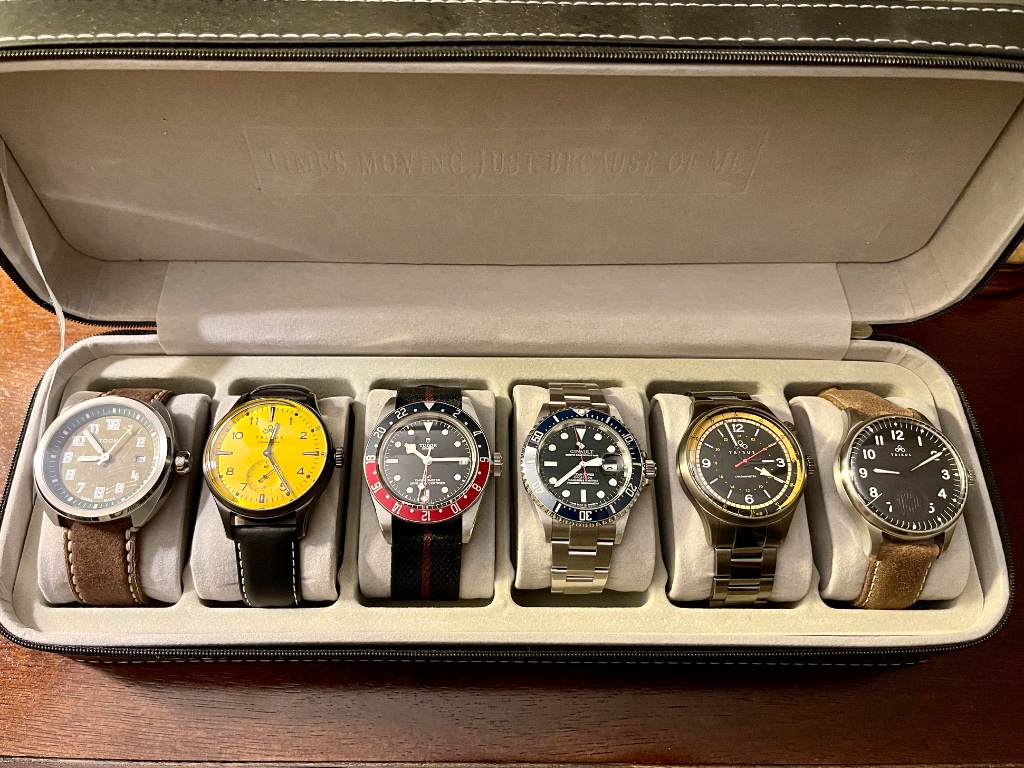
In a hobby that can sometimes drift toward spectacle, the field watch brings us back to first principles. Perhaps that is why so many collections, no matter how ambitious, eventually make room for one. And when enthusiasts gather to compare dials, patina, service stories, and favorite straps, it is often the humble field watch that starts the most memorable conversations.