
The Final Frontier of Horology
When we talk about tool watches, we often speak in hyperbole—calling a diver 'capable of exploring the depths' or a pilot 'perfect for the cockpit.' But there is one theater of operation that truly separates the legends from the pretenders: the vacuum of space. To survive outside the Earth's atmosphere, a watch must withstand extreme thermal cycling, zero gravity, and the crushing pressure of G-forces. This is the history of the instruments that traveled to the stars.
The Pioneers: First Watches in Orbit
Before the Omega Speedmaster became the de facto choice for NASA, space exploration was an experimental frontier. The first watch known to have reached space on a human wrist was the Sturmanskie worn by Yuri Gagarin during Vostok 1 in 1961. Produced by the First Moscow Watch Factory, this manual-wind movement was humble, rugged, and functional. It wasn't the high-tech Swiss chronographs we fetishize today, but it proved that a standard mechanical movement could tick in microgravity.
The Mercury-Atlas Era
Before NASA adopted official government-issued gear, astronauts were famously individualistic. John Glenn, during his 1962 Friendship 7 flight, wore a Heuer 2915A stopwatch strapped over his suit. It was a utilitarian choice, but it cemented the idea that space travel required precise, external timing instruments.
The Legend: Omega Speedmaster Professional
If there is one watch synonymous with space, it is the Omega Speedmaster Professional. After a grueling testing process in 1965—where NASA subjected candidates to vacuum, high pressure, extreme heat, and severe vibration—the Omega was the only one to remain functional. It earned the moniker 'Flight Qualified for All Manned Space Missions.'
Why the 'Moonwatch' Matters
When Buzz Aldrin stepped onto the lunar surface in 1969, his Speedmaster reference 105.012 became the first watch on the moon. Beyond the marketing, the mechanical reliability of the Caliber 321 movement is a testament to mid-century engineering. I remember looking at a vintage 105.012 under a loupe for the first time; there is a tangible sense of history in the way the chronograph pushers feel—stiff, deliberate, and engineered for a purpose far greater than checking the time at a board meeting.
The Modern Era: G-SHOCK and Beyond
Modern space travel has evolved, and so has the equipment. Today, you are just as likely to see a digital Casio G-SHOCK floating in the ISS as you are an Omega. The G-SHOCK DW-5600 has become a modern classic among astronauts for its lightweight resin construction and unmatched shock resistance. It isn't a luxury item, but it is a masterclass in functional design.
Curating Your Own Collection
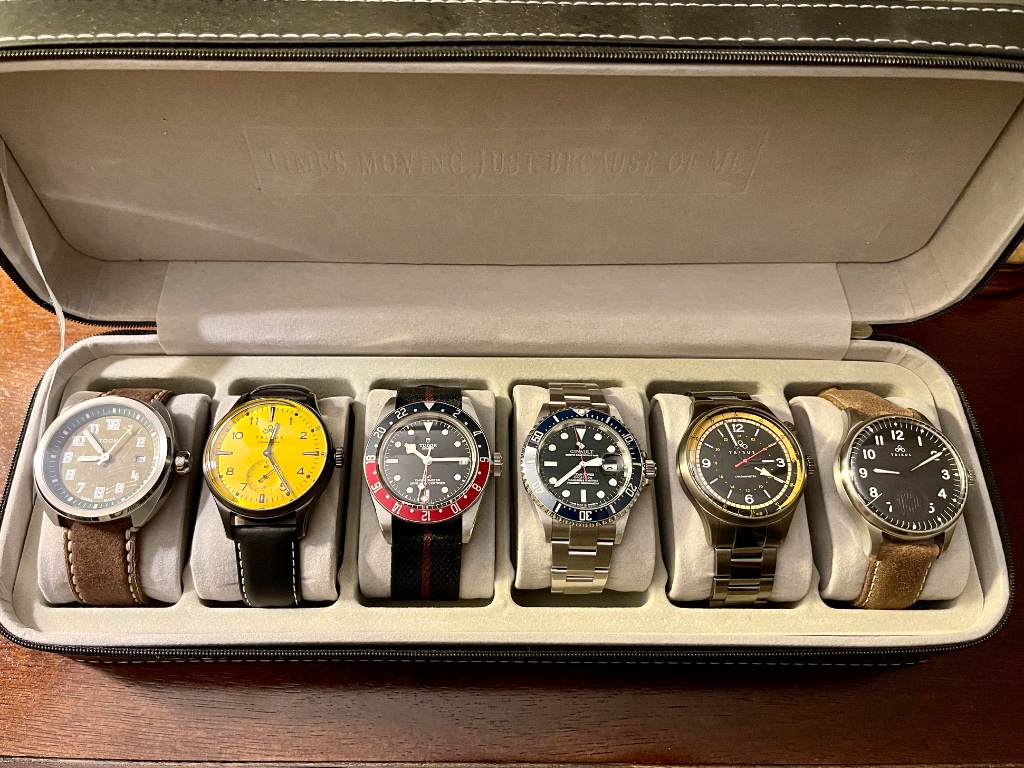
Collecting space-faring watches can be an expensive hobby, especially when chasing vintage Omega references that trade for tens of thousands of dollars. That is exactly why we created the Keeperbox Watch Club. We believe that every collector deserves to experience the weight of a professional chronograph on their wrist—whether it's the history of a Speedmaster or the modern precision of a Breitling. Our rotation program allows you to wear these icons of space travel, understand their history firsthand, and decide what truly belongs in your personal collection without the pressure of a permanent purchase. Join us today and start your mission.