

For most collectors, storage sounds like the quiet part of the hobby. The exciting moments are the hunt, the unboxing, the first wrist shot in morning light. But talk to seasoned enthusiasts long enough and a pattern emerges: the watches that age best are usually the ones that have been worn thoughtfully and stored even more thoughtfully.
A good watch is a compact machine, yes, but it is also a set of vulnerable surfaces, lubricated tolerances, seals, gaskets, springs, and finishing details that respond to their environment. Whether you’re rotating between a Hamilton Khaki Field Mechanical, a Seiko Prospex diver, a Citizen Series 8, or something from Farer, Formex, Baltic, or Venezianico, long-term storage has a direct impact on how that watch will look, run, and feel years from now.
Storage Is Preservation, Not Decoration
Collectors often begin with display. A handsome box, a glass top, maybe a dresser placement that lets the collection catch the afternoon sun. It looks right, but preservation and presentation are not always the same thing.
The biggest enemies of a resting watch are surprisingly ordinary: humidity, dust, ultraviolet light, magnetic fields, and careless positioning. None announces itself dramatically. Instead, they work slowly. Leather straps stiffen and fade. Polished surfaces pick up micro-abrasions from poor contact. Oils inside mechanical movements age in less-than-ideal conditions. Gaskets dry out. The watch that seemed “safely put away” begins to show that it wasn’t quite as protected as it appeared.
That is why serious storage begins with a shift in mindset. Your watch box is not just furniture. It is a controlled environment, or at least it should be as close to one as practical in a home setting.
The Ideal Home for a Resting Watch
In broad terms, watches like stable conditions. A cool, dry room is far better than an attic, a bathroom cabinet, or a bedside table next to a sunlit window. If the room is comfortable for books, cameras, and leather goods, it is usually a decent starting point for watches too.
Humidity matters more than many newcomers realize. Excess moisture can encourage corrosion, degrade straps, and compromise the long-term integrity of packaging and papers if you keep those nearby. Very dry conditions, meanwhile, can be unkind to leather. For most collections, a moderate indoor environment with good airflow is enough. Silica packets in a watch box or safe can help, provided they are changed periodically rather than forgotten.
Light is another slow hazard. Sunlight will not ruin a watch in an afternoon, but over time it can fade straps, alter dial tones, and age materials unevenly. Collectors who love the warm cream of tritium patina may still prefer to let that story happen naturally, not by baking a watch in direct exposure. A closed box, drawer, or cabinet remains the better option.
Watch Boxes, Rolls, and Safes: Choosing the Right Format
The best storage choice depends on how you collect. A six-watch rotation has different needs from a twenty-piece accumulation of divers, field watches, and vintage dress references.
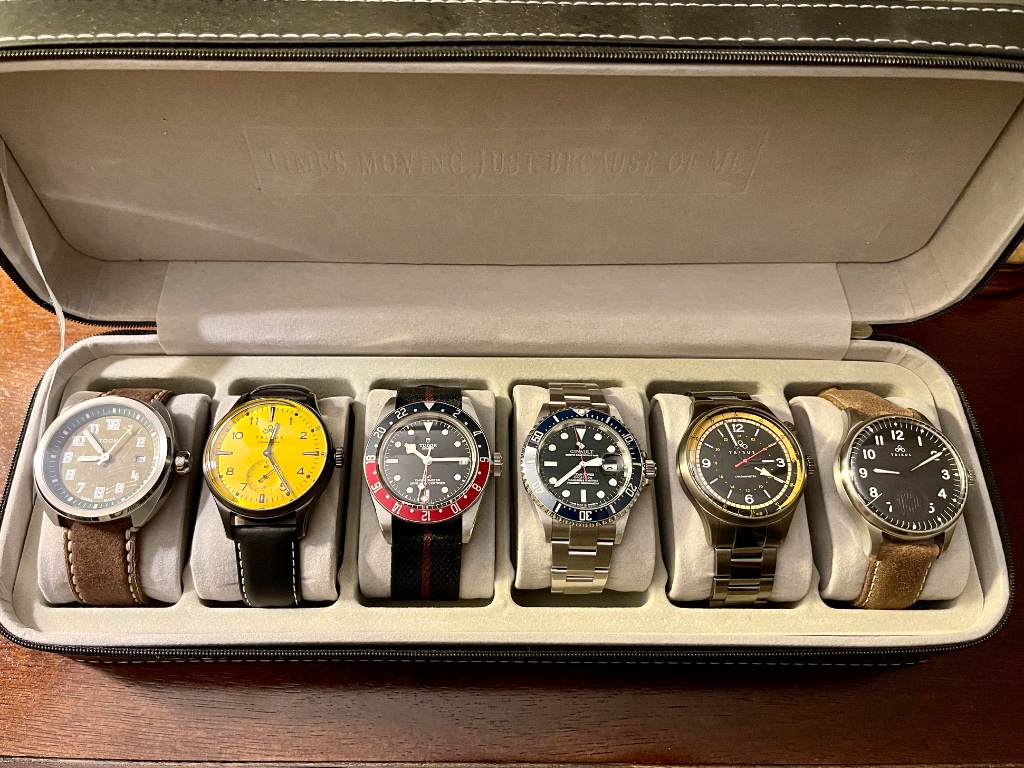
For daily practicality, a well-made watch box is hard to beat. Look for soft, non-abrasive lining, pillows that support the bracelet or strap without forcing it into an unnatural curve, and enough spacing that crowns and case flanks are not knocking into neighbors. This sounds obvious until you see oversized modern sports watches crammed beside slim vintage pieces.
Travel rolls are excellent for transport and short-term storage, especially for collectors who rotate watches between home, office, and weekend travel. Brands like Baltic and Farer have helped normalize the idea that compact collections deserve elegant, functional storage. The key is fit: too loose and the watch shifts; too tight and you put needless stress on straps.
For higher-value collections, a safe offers security, but it introduces its own maintenance logic. A sealed safe can trap moisture if the internal environment is not managed. If you keep watches in one, add humidity control and avoid stacking accessories loosely around them. Security should not come at the expense of preservation.
Mechanical vs Quartz: Store Them Differently?
Yes, though the differences are subtle.
Mechanical watches generally do well resting in a stable environment, unwound or partially wound after wear. There is little benefit in constantly handling a watch just to keep it “alive” if you are not wearing it. A hand-wound Hamilton or a Miyota-powered microbrand from Mitch Mason or NEUTRA can sit quite happily between wears if stored properly.
Automatic watches invite a more debated topic: winders. For most collections, a winder is optional, not essential. It can be useful for perpetual calendars or watches you wear frequently and want ready at a moment’s notice. But for standard three-hand automatics using movements like the Sellita SW200, ETA 2824 family, or Seiko’s 6R series, rest is not harmful. In fact, reducing unnecessary running hours may be preferable over the very long term.
Quartz watches deserve one specific caution: batteries. If a quartz watch is going into long-term storage, especially for many months, consider battery condition carefully. A dead or leaking battery can do far more damage than a resting mechanical movement ever will. A Citizen Eco-Drive changes the equation somewhat, since it benefits from periodic light exposure, though not harsh direct sun for prolonged stretches. The principle remains the same: understand the power system of the watch you own.
Bracelets, Straps, and Positioning
Collectors often focus on movements and forget the supporting cast. Yet straps age faster than calibers when neglected.
Leather should be stored clean, dry, and away from heat. If you have worn a dress watch in summer, let the strap air out before placing it back in the box. Trapped perspiration is one of the quickest routes to odor, cracking, and premature wear. Rubber is more forgiving, though it still benefits from a quick wipe-down, especially after saltwater exposure. Bracelets should be closed gently, not forced around an undersized cushion that adds tension over time.
Positioning also matters. Lay watches so crystals and polished surfaces are protected from friction. If your box uses pillows, make sure lug-to-lug dimensions actually suit the compartment. A compact 36mm field watch and a broad-shouldered Formex Reef should not be treated identically.
The Forgotten Part: Preparation Before Storage
The best storage habits begin before the watch ever reaches the box.
Wipe the case and bracelet with a clean microfiber cloth after wear. If the watch has seen sweat, dust, or sea air, a gentle fresh-water rinse may be appropriate for models with suitable water resistance, followed by careful drying. A Seiko diver or Citizen Promaster can usually handle this with ease; a vintage dress piece on leather, obviously, cannot. Common sense remains one of the collector’s most valuable tools.
It is also wise to avoid putting a watch away with unresolved issues. Condensation under the crystal, a crown that no longer screws down smoothly, or an accuracy shift that feels abrupt should not be deferred simply because the watch is headed into rotation storage. Small faults tend to become larger, more expensive ones when ignored in the dark.
Storage as a Form of Respect
There is a deeper reason this subject matters. Good storage is not merely about resale value, though it certainly helps preserve condition. It is about respect for the object and for the craft behind it.
Whether the watch on your wrist houses a modest Seiko caliber, a robust Sellita, or a beautifully finished Swiss movement from a more elevated independent maker, it was built to accompany life. Caring for it properly between those moments of wear is part of the relationship collectors develop over time. It is one of the quiet disciplines that separates accumulation from stewardship.
And perhaps that is why the topic resonates so strongly in enthusiast circles. Ask ten collectors how they store their watches and you will hear ten variations on the same instinct: protect what you love, and make it easy to enjoy again tomorrow. Around a table of fellow enthusiasts, in conversation or in the company of a well-built watch box, that instinct starts to feel less like maintenance and more like belonging.