

A good watch is built to be worn
One of the quiet pleasures of collecting watches is learning that ownership is really stewardship. A watch may feel personal from the first day you strap it on, but in truth, most well-made pieces are built for a lifespan far longer than any single owner. Whether it is a Hamilton Khaki Field with the dependable H-10, a Seiko Alpinist with its familiar 6R movement, or a Baltic powered by a Miyota caliber, proper care is less about fussiness than respect.
That matters because watches do not simply get old; they wear according to the life we give them. The difference between attractive patina and avoidable deterioration often comes down to a handful of habits. The goal is not to keep every case flank pristine or every bracelet clasp free of marks. A loved watch should show life. The aim is to preserve the integrity of the movement, the seals, the dial, and the finishing so the watch can mature with dignity.
Daily habits make the biggest difference
Most watch care begins long before a service bench is involved. It starts with how you wear the piece. If you own several watches, rotation is healthy not only for your collecting instincts but for wear distribution. The watch you grab every morning will naturally pick up more scratches, sweat, and impact exposure than the others.
A quick wipe with a soft microfiber cloth at the end of the day goes further than many collectors realize. Skin oils, dust, and moisture settle around lugs, bezels, and casebacks. Left alone, they can dull finishing and work their way into bracelet links or under spring bars. On a bracelet watch like a Formex Essence or Citizen Tsuyosa, this small ritual helps preserve both appearance and comfort.
Crown discipline matters too. If a screw-down crown is left partially unscrewed after winding or setting, water resistance is compromised immediately. It sounds obvious, but even seasoned enthusiasts have been caught out after changing the date in a hurry. Likewise, setting the date during the danger zone on many mechanical movements, often roughly between 9 p.m. and 3 a.m., can stress the calendar mechanism. If you own a Sellita SW200-1, ETA 2824 derivative, or Seiko 4R36, it is simply good mechanical sympathy to move the hands first, then set the date.
Water resistance is not permanent
Collectors often speak of water resistance as if it were a permanent trait, but it is better understood as a condition. Gaskets age. Temperature swings harden seals. A watch rated to 200 meters when new is not permanently immune to moisture ten years later.
This is where realism is more useful than marketing. A diver from Seiko, Citizen, or Squale is made for genuine water use, but only if its seals remain healthy. A dressier microbrand with 50 meters on the dial may shrug off hand washing, yet it is not the watch to wear into a pool on vacation. Leather straps complicate things further. Even when the case can tolerate moisture, leather rarely enjoys it.
If you swim regularly with a watch, have the water resistance tested periodically, especially before summer or travel. It is a modest cost compared with the heartbreak of a fogged crystal and a stained dial. Anyone who has seen condensation creep under the sapphire of a beloved Farer or NEUTRA will tell you that prevention feels very inexpensive afterward.
After saltwater, rinse the watch under fresh water if the case is rated appropriately and the crown is secure. Salt is wonderfully efficient at making steel, rubber, and moving parts miserable over time.
The invisible enemies: shock and magnetism
Mechanical watches are more robust than many newcomers assume, but they are still miniature machines. That means shock and magnetism deserve respect.
A modern movement with Incabloc or a similar shock protection system can handle ordinary life well. Your Hamilton, Tissot, or Mitch Mason is not a Fabergé egg. But chopping wood, using a hammer drill, or spending an afternoon at the driving range with a mechanical watch on the wrist is another matter. Repeated vibration can upset amplitude, loosen components, and hasten wear. For those moments, a quartz beater or a solar Citizen Eco-Drive is not a compromise in taste. It is good judgment.
Magnetism is subtler. Laptops, phone cases with magnetic closures, speakers, induction cooktops, and even handbag clasps can affect timekeeping. A watch that suddenly starts running dramatically fast may simply be magnetized. The good news is that demagnetizing is quick and inexpensive, and in many cases immediate. For collectors who enjoy accessible mechanicals, from a Seiko 5 Sports to a Venezianico with a Sellita movement, this is one of the easiest issues to solve if you recognize it early.
Service should be thoughtful, not obsessive
One of the most common questions in watch collecting is how often a mechanical watch should be serviced. The unhelpful but honest answer is that it depends. Brand guidance is useful, but so is common sense. A modern watch that is keeping stable time, winding smoothly, and showing no signs of moisture or grinding does not necessarily need to be rushed to the workshop simply because a calendar says so.
At the same time, waiting until a movement is clearly struggling is not ideal either. Lubricants degrade, and metal does not like running dry. For many everyday mechanicals, a general window of five to eight years is sensible, though usage matters. A frequently worn SW200, Miyota 9015, or Seiko 6R may need attention sooner than a lightly worn watch that lives in rotation.
Just as important is where you send it. A competent independent watchmaker can be an excellent choice, especially for common Swiss and Japanese calibers. For heavily branded finishing, complicated models, or vintage pieces with fragile original parts, manufacturer service may be worth the extra time and expense. The best collectors learn this early: not every watch requires the same service path.
Straps, bracelets, and storage tell the rest of the story
A watch’s condition is shaped as much by what surrounds it as by the movement inside. Straps deserve seasonal thinking. Leather likes air, not sweat. Rubber likes rinsing. Fabric NATO straps can collect grit that slowly wears the underside of lugs if never cleaned. If you rotate often, giving straps a rest between wears extends their life noticeably.
Bracelets benefit from occasional warm water and mild soap, provided the watch itself is appropriately water resistant. A surprising amount of grime hides between links. Clean metal simply wears better.
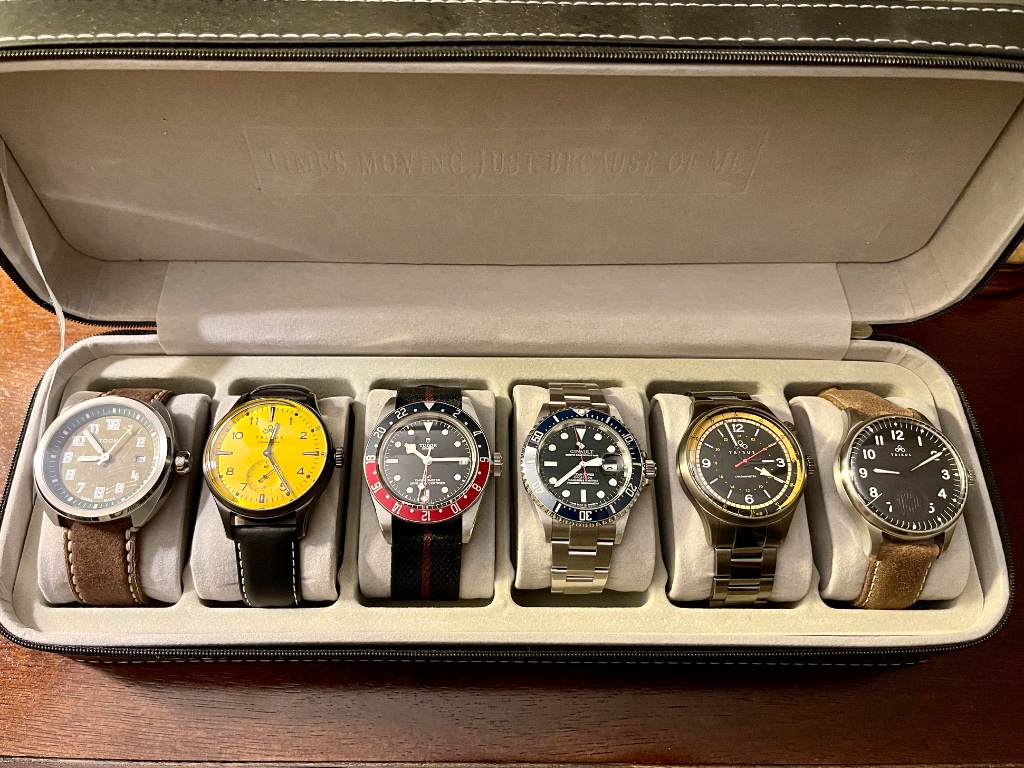
Storage should be dry, temperate, and calm. A watch box is not only decorative; it protects crystals and polished surfaces from the random indignities of a dresser top. Watch winders are useful for some owners, especially with perpetual calendars or awkward-to-set pieces, but they are not mandatory for most collections. A simple Keeper Box-style setup, where each watch has a safe, padded place to rest between wears, is often the more elegant answer.
Let it age, but do not let it slide
The most seasoned collectors understand that caring for a watch is partly technical and partly philosophical. A scratch on the clasp of a Seiko diver, a softened edge on a well-traveled Hamilton, or the deepening warmth of a leather strap on a Baltic are not flaws to fear. They are records of use. What deserves vigilance is neglect: moisture in the case, dirt in the bracelet, dried seals, old lubricants, and careless impacts.
That distinction is what separates ownership from stewardship. The best-kept watches are rarely the ones locked away untouched. They are the ones worn with pleasure, cleaned with intention, serviced with restraint, and understood a little better each year. In that sense, watch care is one of the most satisfying parts of the hobby. It teaches patience, mechanical empathy, and the long view.
And, perhaps most of all, it reminds us that collecting is richer when knowledge is shared. Every enthusiast has a lesson learned the hard way, a favorite watchmaker, or a maintenance ritual that has become second nature. Those conversations are part of what makes a true watch community feel valuable long after the unboxing is done.