
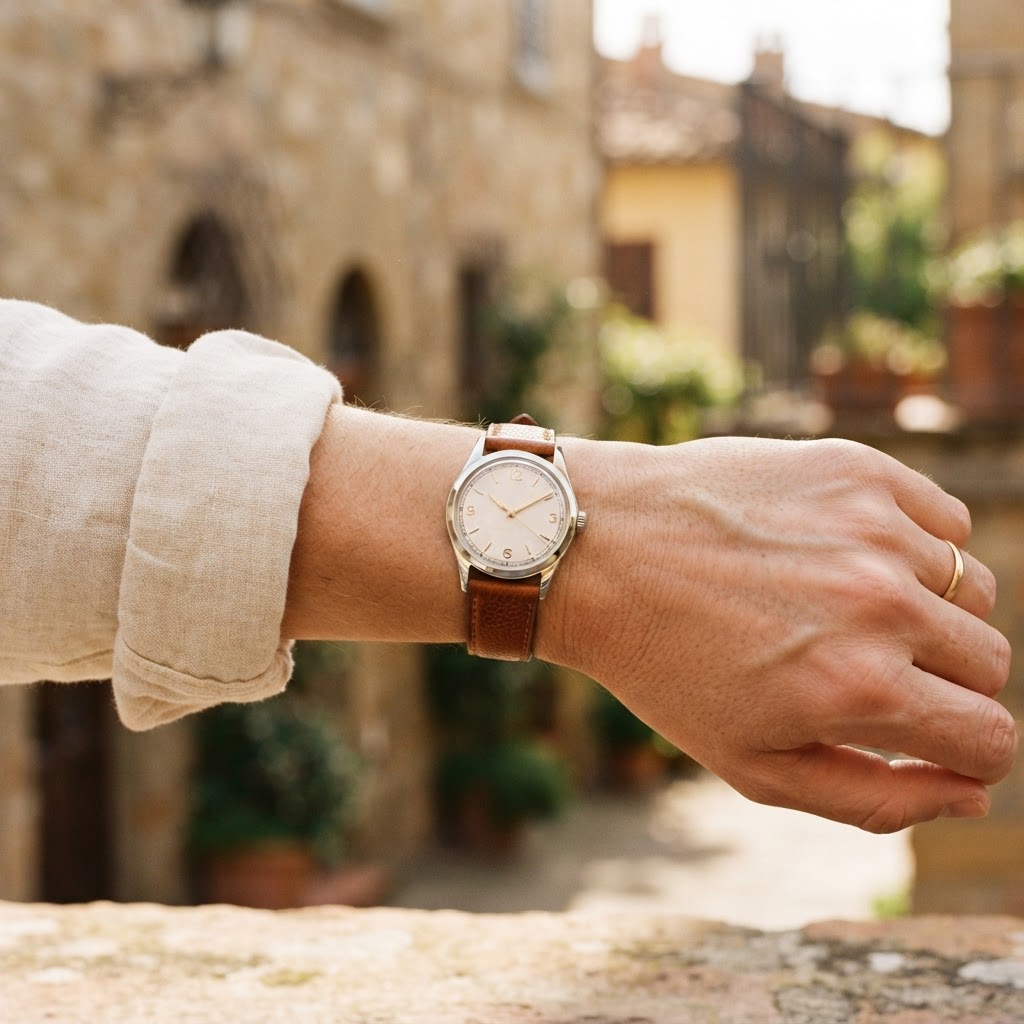
A great watch can sharpen an outfit, but the relationship between watches and style is often misunderstood. Too many collectors start with rules: never wear this with that, always match your strap to your shoes, keep sport watches away from tailoring. In reality, the most stylish watch enthusiasts tend to be the ones who understand proportion, context, and personality better than rigid etiquette.
The best watch pairing is rarely about following a formula. It is about choosing a piece that feels coherent with the rest of what you are wearing and honest to who you are.
Style starts with the watch, not the category
Collectors often speak in categories: diver, field watch, dress watch, GMT, chronograph. Those classifications matter, but they do not tell the whole story. A Seiko Prospex diver and a Blancpain Fifty Fathoms are both dive watches, yet they project very different moods. One may feel rugged and practical, the other luxurious and historically rich.
What matters most in style terms is the visual language of the watch. Case finishing, dial color, bezel shape, bracelet design, and thickness all influence how a piece wears. A Hamilton Khaki Field Mechanical, for example, is technically utilitarian, but its restrained dial and compact profile make it versatile enough to pair with denim, knitwear, or a softly tailored jacket. A Farer chronograph, by contrast, often leans more expressive because of its color choices and playful detailing, making it a stronger statement piece even in similar casual settings.
When deciding whether a watch suits your look, ignore the category label for a moment. Ask instead: does this piece feel clean, relaxed, technical, refined, bold, or understated? That answer will tell you more than the brochure ever could.
Proportion is the quiet engine of elegance
If there is one principle worth taking seriously, it is proportion. Watches affect style most when their size and visual weight align with both your wrist and your clothing.
A slim watch tends to complement finer textures and cleaner lines. Think of a Baltic MR01 under a cuff, or a hand-wound dress piece with a modest diameter worn with an unstructured blazer. These watches do not need to dominate. Their appeal lies in discretion.
By contrast, a more robust case can work beautifully with heavier fabrics and casual silhouettes. A Citizen Promaster, a Seiko Turtle, or a Formex Reef feels right with flannel, boots, chore coats, and textured outerwear because the visual heft matches the clothing.
This is where many new collectors go wrong. They focus only on diameter, when thickness, lug-to-lug length, and dial openness often matter just as much. A 39mm watch with a long lug span can wear larger than expected, while a 41mm diver with a compact case may feel balanced. Style is not only about whether a watch fits the wrist. It is about whether it fits the whole picture.
Color should echo, not compete
Matching a watch to your style does not require exact coordination. In fact, exact matching often feels forced. The more sophisticated approach is to let your watch echo tones already present in your outfit.
A deep blue dial can pick up navy trousers, indigo denim, or even cooler gray tailoring. A cream dial works beautifully with earth tones, suede, and softer neutrals. Black dials are versatile, but they can feel quite different depending on finish. A glossy black dial with polished markers may lean dressier than a matte black field watch.
This is one reason brands like NEUTRA, Venezianico, and Mitch Mason have gained attention among enthusiasts who care about style as much as specifications. They understand that color and texture create emotional appeal. A fumé dial, gilt handset, or brushed steel bezel may not change the function of a watch, but it can completely change how it interacts with your wardrobe.
Straps deserve equal attention. A beads-of-rice bracelet softens a case. A suede strap can make even a straightforward three-hander feel warm and relaxed. Rubber brings modernity and energy. Leather, especially in a rich brown or black, still has few rivals when you want a watch to feel grounded and complete.
Formality is more flexible than it used to be
The old hierarchy placed dress watches at the top of formal wear and sports watches everywhere else. That framework still has some truth to it, but modern style is far more fluid.
Today, a well-chosen steel sports watch can look entirely at home with tailoring, particularly if the suit is not overly formal. A 36mm to 40mm watch with a slim profile and restrained dial can bridge casual and refined settings with ease. Think of the elegance of an Omega Aqua Terra, the everyday polish of a Rolex Datejust, or the clean confidence of a Seiko Sharp Edged piece.
Even among more accessible brands, this versatility is alive and well. A Hamilton Jazzmaster, a Baltic HMS, or certain models from Formex and Farer can move from office to dinner without missing a beat. The key is not whether the watch was designed as a dress piece, but whether its design is disciplined enough to sit comfortably alongside sharper clothes.
That said, black tie remains one place where understatement still wins. A thin, time-only watch on leather will always feel more effortless than a large dive watch peeking from beneath a dinner jacket sleeve. Not because of old-fashioned rules, but because elegance often depends on restraint.
Personal style should outrank convention
Some of the most memorable watch pairings work precisely because they are not textbook. A vintage-inspired diver with a linen suit in summer. A gold-toned watch with a gray sweatshirt and worn denim. A field watch on leather with tailored wool trousers.
What makes these combinations successful is intention. When a collector knows why a watch belongs in the mix, the result feels expressive rather than random.
This is where seasoned enthusiasts often develop a confidence that beginners admire. They stop chasing approval and start curating for themselves. Maybe that means wearing a Seiko 5 on most days because it feels honest and unfussy. Maybe it means rotating between a Citizen Tsuyosa, a Hamilton Khaki, and a Farer GMT depending on mood rather than occasion. Maybe it means discovering that a modest microbrand with thoughtful finishing gives more style satisfaction than a more famous name.
Collector wisdom usually arrives here: the watches you wear most are rarely the ones that check the most boxes on paper. They are the ones that feel natural when you fasten them on.
Build a wardrobe of watches, not just a collection
The most satisfying collections often resemble a good wardrobe. Not endless duplication, but a set of pieces with distinct roles, textures, and moods.
You might have a clean everyday watch, a tougher weekend piece, something slimmer for more polished settings, and one watch that is simply there for joy. That joy could come from a mechanical curiosity like a hand-wound movement, a reliable workhorse such as the Seiko NH35 or Miyota 9039, or a beautifully executed Swiss caliber from Sellita. Movement matters, but style lives on the outside. The ideal watch gives you both.
If you are early in your collecting journey, resist the urge to buy for hypothetical occasions. Buy the watch that suits the life you actually live and the clothes you actually wear. If you are deeper into the hobby, revisit the pieces that once felt ordinary. You may find that your most versatile watch was quietly your most stylish all along.
In the end, matching your watch to your style should be enjoyable, not anxious. A watch is one of the few objects we wear that can signal taste, curiosity, discipline, and memory all at once. The trick is not perfection. It is coherence.
And when collectors gather to compare notes, swap straps, and notice the details others miss, that is often where style becomes something richer than self-expression alone. It becomes a shared language.