
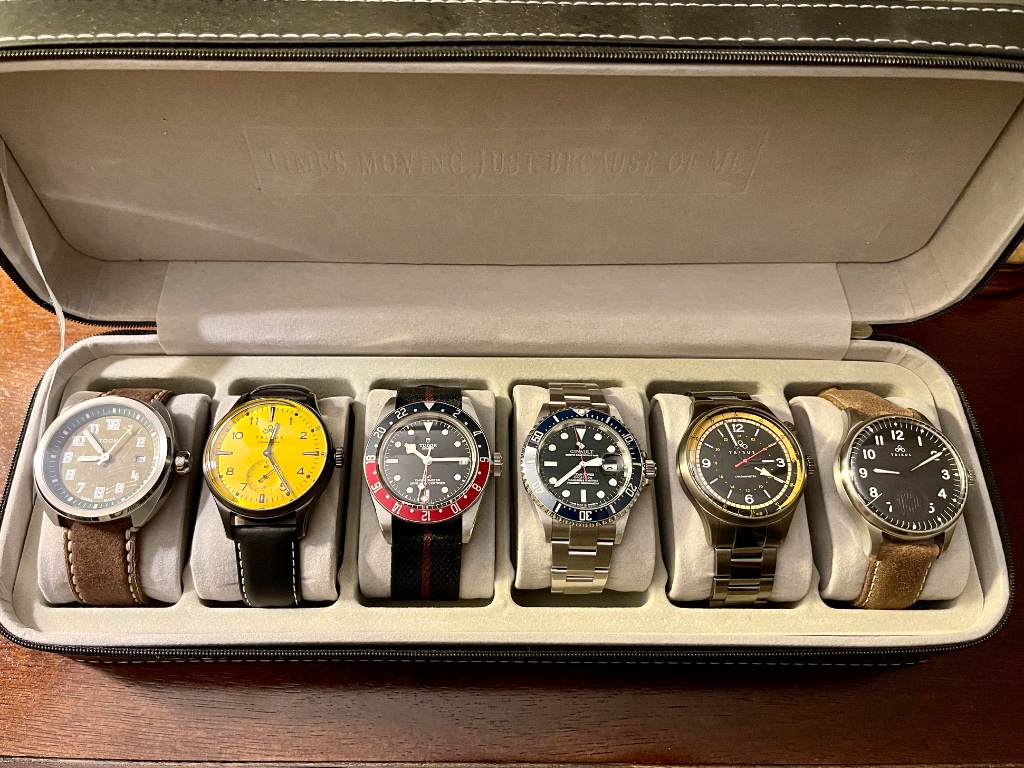

A good watch collection is not a race to fill a box. It is a gradual expression of taste, curiosity, and lived experience. For some collectors, it begins with a first automatic from Seiko or Hamilton. For others, it starts with a quartz Citizen bought for pure utility, only to become the watch that quietly opens the door to horology. However it starts, the most satisfying collections tend to have one thing in common: they are built with intention.
In a market saturated with hype, limited releases, and algorithm-driven enthusiasm, that intention matters more than ever. The collectors whose watch boxes feel alive rather than merely expensive are often the ones who learned to look beyond resale chatter and ask a better question: what kind of collection will still feel meaningful in ten years?
Start with a point of view, not a purchase
New collectors often ask which watch they should buy first, but the more useful question is what they want their collection to say. That does not mean performing for others. It means understanding the sensibility that draws you in.
Are you captivated by field watches with military roots, like the Hamilton Khaki Field Mechanical? Do you prefer the polished restraint of a dress watch, perhaps something inspired by mid-century proportions from Baltic or NEUTRA? Or are you pulled toward modern sports watches that balance ruggedness and refinement, like the Formex Essence or a well-executed dive watch from Farer or Mitch Mason?
A collection with character usually has some internal logic. It may be built around a design language, a historical period, a country of origin, or a type of use. One collector may pursue accessible Japanese tool watches, moving from a Seiko 5 to a Prospex and then toward higher-end Citizen Series 8 pieces. Another may focus on contemporary independents and microbrands, appreciating how companies like Venezianico or Baltic reinterpret familiar forms with fresh energy.
Without a point of view, collecting can become accumulation. With one, even a modest three-watch collection can feel deeply considered.
Learn the difference between variety and redundancy
One of the quiet skills in collecting is recognizing when a new watch adds dimension and when it simply repeats what you already own. This is harder than it sounds. A black-dial diver with a gilt handset may feel entirely different from another black-dial diver on paper, but in daily wear the overlap can be significant.
Variety is not only about style categories. It can come from size, movement type, finishing, and emotional register. A collection might include a hand-wound field watch, a solar-powered grab-and-go piece, a textured-dial integrated-bracelet model, and a dress watch on leather. That creates a richer experience than owning four watches that all occupy the same visual and practical space.
This is where trying watches on, living with them, and resisting impulse purchases become essential. The Seiko Alpinist, for example, offers a very different personality from a Citizen Promaster diver, even if both sit in the broad category of sport watches. Likewise, a Baltic MR01 brings a dressier, more contemplative mood than a Hamilton Khaki Automatic, despite both being versatile everyday pieces.
The mature collector learns to identify not just what looks good in photos, but what broadens the collection in a real way.
Respect movements, but do not worship specifications
Watch enthusiasts naturally enjoy movements. We should. They are the beating heart of horology, whether that heart is mechanical, quartz, solar, or hybrid. But one of the most useful lessons in collecting is that movement quality is only one part of a watch’s value.
A robust ETA 2824 or Sellita SW200 can be more satisfying over years of ownership than a technically ambitious caliber hidden inside a poorly resolved case design. A Miyota 9039 in a well-proportioned microbrand release can deliver far more daily pleasure than a more exotic movement in a watch that never feels comfortable on the wrist.
This is especially relevant in today’s enthusiast market, where spec sheets often dominate conversation. Sapphire crystal, 200 meters of water resistance, applied indices, on-the-fly clasp adjustment, chronometer claims: all welcome, none sufficient on their own. The best watches turn specifications into experience.
Think of the appeal of the Hamilton Khaki line, or the enduring enthusiasm around certain Seiko references. It is not merely the movement architecture. It is coherence. The design, proportions, legibility, and tactile feel come together in a way that makes the watch easy to love.
Collector wisdom often lies in seeing the whole object, not just its technical résumé.
Let your collection include both anchors and experiments
The strongest collections usually balance dependability with curiosity. Anchors are the watches that define your taste and remain satisfying year after year. They are not necessarily the most expensive pieces, but they are the ones you would struggle to part with. A trusted Omega or Tudor may serve this role for one collector; for another, it may be a humble Seiko SARB033 or a Hamilton Murph that always feels right.
Experiments are equally important. They are how taste develops. A colorful Farer, a crisp Venezianico bracelet sports watch, or an unusual sector-dial piece from Baltic might introduce you to proportions, textures, or hues you had not previously considered. Not every experiment becomes a permanent resident, and that is part of the point.
Collectors sometimes feel pressure to buy only “safe” watches with broad approval. But personal taste matures through friction. The piece that divides opinion may teach you more than the universally praised one.
A living collection should have room for both confidence and discovery.
Buy slower, observe longer
If there is one principle that improves almost every collection, it is patience. The modern watch world moves quickly, and excitement can be contagious. Yet many regrettable purchases share the same origin: too little time between desire and decision.
Before buying, study the watch in different contexts. See it on wrist if possible. Read owner impressions six months after launch, not just release-week reactions. Pay attention to case thickness, lug-to-lug length, clasp comfort, dial legibility, and serviceability. These practical details shape long-term satisfaction far more than initial novelty.
This matters particularly with microbrands, where innovation and value can be remarkable but consistency varies. Brands like Formex and Baltic have earned strong reputations for a reason, while newer names may still be proving themselves. That does not mean avoiding risk. It means matching your enthusiasm with due diligence.
In collecting, restraint is not the opposite of passion. It is one of its highest forms.
Build a collection that reflects your life
Ultimately, a lasting watch collection should make sense not only on a tray, but in the context of your actual days. The best collections are wearable. They move between office, travel, weekends, dinners, and quiet mornings without feeling theoretical.
That might mean owning fewer watches than you first imagined. It might mean keeping a quartz Citizen for convenience alongside a mechanical core, or making room for a rugged beater even after acquiring more refined pieces. A collection does not become serious by becoming impractical.
What gives a watch collection character is not price, rarity, or internet approval. It is the evidence of a collector paying attention: to design, to craft, to use, to memory, and to the subtle evolution of taste over time. The watches that endure are the ones that continue to feel like you.
That is the enduring pleasure of this hobby. We are not simply acquiring objects. We are learning how to see more clearly, choose more thoughtfully, and appreciate more deeply. And in the right company, those lessons become even richer, passed from one enthusiast to another across wrist shots, spirited debates, and the quiet satisfaction of a well-loved watch box.