
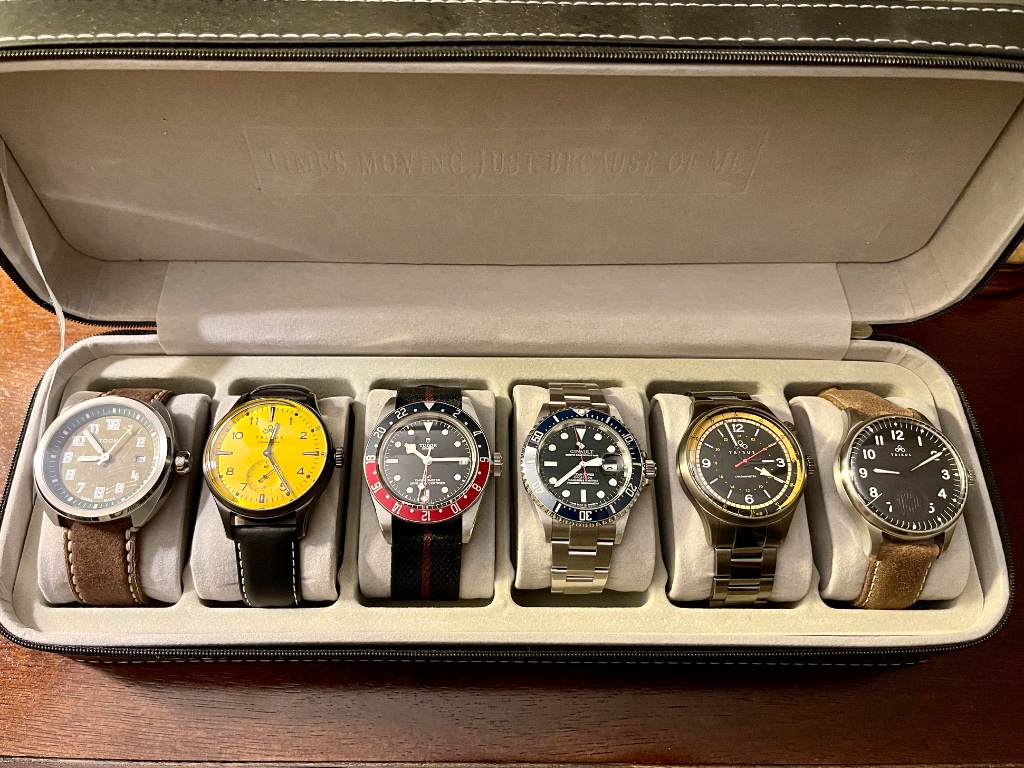

For many of us, collecting watches begins with a single spark: a Seiko bought on a milestone birthday, a Hamilton field watch discovered while reading about military design, or a vintage-inspired Baltic that suddenly makes everything else in the watch box look a little too loud. What starts as appreciation quickly becomes study, then obsession, then something more meaningful. A good watch collection is never just an accumulation of objects. At its best, it becomes a portrait of taste, curiosity, memory, and self-knowledge.
The temptation early on is to collect broadly and quickly. There is so much to discover, and modern watchmaking has never been more diverse. Heritage-rich Swiss maisons share space with excellent Japanese stalwarts, while independent makers and microbrands continue to challenge assumptions about value and design. But depth in collecting rarely comes from speed. It comes from learning what truly moves you, and building around that instinct with patience.
Start with a point of view, not a checklist
New collectors often ask what a "complete" collection should include: a diver, a dress watch, a chronograph, perhaps a GMT, and something vintage. That framework can be useful, but only up to a point. The strongest collections are not built from categories alone. They are shaped by a coherent point of view.
Maybe you are drawn to mid-century restraint: a clean Nomos-like dial, dauphine hands, small seconds, and cases that disappear under a cuff. Maybe you prefer practical tool watches with real-world utility, where a Citizen Promaster, a Seiko Prospex, and a Formex Reef each express toughness in a different dialect. Or perhaps your taste leans toward contemporary independents and microbrands—Farer for color, NEUTRA for Italian-inflected vintage design, Mitch Mason for adventurous spirit, Venezianico for a distinctly modern Mediterranean flair.
A point of view gives your collection identity. Without it, the watch box can become a random assortment of internet recommendations. With it, even a modest three-watch collection can feel intentional and complete.
Learn the language of watches slowly
One of the great pleasures of collecting is that knowledge compounds. At first, you notice the obvious things: size, color, bracelet comfort, maybe whether a movement is automatic or quartz. Over time, subtler distinctions begin to matter. You learn how lug-to-lug length affects wear more than case diameter. You begin to appreciate finishing not as a vague luxury cue, but as the dialogue between brushed and polished surfaces, sharp bevels, handset quality, and dial texture.
Movements deserve the same measured attention. It is easy to get caught in online hierarchies, but collector wisdom lies in context. A Seiko NH35 may not inspire romance, yet it is robust, serviceable, and entirely sensible in many microbrands. A Miyota 9 series can offer thinness and reliability with a pleasingly modern proposition. Sellita and ETA remain trusted Swiss workhorses for good reason. Then there are movements that deepen attachment through character: the hand-wound experience of a Hamilton Khaki Field Mechanical, or the tactile satisfaction of a chronograph with thoughtful pusher feel.
You do not need to become a watchmaker to collect well. You simply need to stay curious, and resist the urge to confuse price with insight.
Buy watches you will actually wear
This sounds obvious, but it is perhaps the hardest lesson in collecting. Enthusiasts are especially vulnerable to buying watches they admire intellectually but do not connect with physically. A watch can be historically important, beautifully reviewed, and impeccably specified, yet still leave you cold on the wrist.
The wrist is a truth-teller. It reveals whether a 42mm diver is energizing or cumbersome, whether faux patina feels charming or theatrical, whether a beads-of-rice bracelet sings or rattles. A Farer might win you over with color in press photos, only for a restrained black-dial watch to become your daily companion. Or the opposite may happen: a supposedly safe choice fades into the background while an expressive piece becomes indispensable.
Whenever possible, handle watches in person. If you cannot, study dimensions carefully and read beyond the headline verdicts. Long-term owner impressions are often more useful than launch-day excitement. The goal is not simply to acquire good watches. It is to acquire your watches.
Let versatility and specificity coexist
A mature collection usually contains both. Versatile pieces earn their place because they meet life where it is: office, travel, weekends, dinners, odd Tuesday errands. Think of the easy confidence of an Aqua Terra-style all-rounder, a black-dial Seiko Alpinist, or a well-proportioned Formex Essence. These are watches that reduce friction and invite wear.
But collections become memorable through specificity. A manual-wind chronograph with a telemeter scale. A salmon dial that only makes sense to you. A quirky compressor-style diver from Baltic. A vintage-inspired jump hour that most people would never buy twice, let alone once. Specific watches sharpen the edges of a collection. They reveal taste, courage, and a willingness to prioritize delight over utility.
The art is in balance. If every watch is trying to be the hero, the collection becomes noisy. If every watch is sensible, it risks becoming anonymous.
Respect your budget, but also your attention
Smart collecting is not merely about spending less. It is about spending deliberately. A lower-priced watch bought in haste can be more costly than an expensive watch chosen carefully, because the real waste in collecting is not money alone. It is attention, enthusiasm, and emotional bandwidth spent on pieces that never quite belonged.
This is why many seasoned collectors eventually slow down. They become less interested in quantity and more alert to redundancy. If you already own two excellent dive watches, a third should bring something genuinely new: a different wearing experience, a distinct movement architecture, a stronger emotional resonance, or a meaningful design language.
There is wisdom in leaving gaps. An empty slot in the watch box can be a sign of discipline, not deficiency.
Document the story, not just the specs
Ask collectors about the watches they truly cherish, and they rarely begin with water resistance or jewel count. They talk about where the watch came from, what period of life it marked, who helped them find it, or why it changed how they saw the hobby.
A collection gains richness when you remember these things. Keep notes. Photograph your watches after scratches appear and straps are changed. Record service history, of course, but also your own evolving impressions. The first time a watch accompanied you on a trip. The moment you realized a piece no longer fit your taste. The friend who persuaded you to try something outside your comfort zone.
These details turn ownership into stewardship. They remind us that collecting is not static. Our tastes refine, our standards sharpen, and occasionally a watch we once overlooked reveals itself years later.
Build a collection that sounds like your voice
In the end, the best watch collection is not the most expensive, the rarest, or the most technically impressive. It is the one that feels unmistakably yours. It might include a humble Citizen alongside a Swiss chronometer, a Hamilton next to a Baltic, a beloved Seiko diver beside a finely finished independent. What matters is the conversation between them.
A meaningful collection has rhythm: familiar themes, a few surprises, and enough honesty to reflect who you are rather than who the market says you should be. If you can look at your watches and see not just purchases but chapters—experiments, lessons, milestones, convictions—then you are collecting well.
That, perhaps, is the real joy of this hobby. Watches keep time, yes, but collecting them teaches patience, discernment, and the pleasure of paying close attention. And in a good community of fellow enthusiasts, that attention only deepens, one story and one wrist-check at a time.